Does Car Sound Deadening Really Matter in 2026? Why Your High-End Audio Needs It
If you have spent any time driving through the busy streets of Calgary lately, you know that the modern driving experience has changed. Cars are getting smarter, engines are getting quieter: or disappearing entirely in the case of EVs: and the technology inside our cabins is more advanced than ever. But there is one thing that hasn’t changed: the laws of physics. Specifically, how sound behaves inside a metal box hurtling down Deerfoot Trail at 100 km/h.
Many people assume that because newer vehicles are marketed as “whisper-quiet,” they don’t need additional sound insulation. However, if you are an audiophile or someone who just invested in premium car audio upgrades in Calgary, you might be surprised to learn that sound deadening is more relevant in 2026 than it has ever been. In fact, it is often the “secret sauce” that separates a good-sounding system from a truly world-class listening experience.
The Misconception of the Modern Quiet Cabin
In 2026, manufacturers are doing more than ever to isolate the cabin from the outside world. We see double-glazed acoustic glass, better door seals, and active noise-canceling technology built into the infotainment systems. For the average commuter, this is great. But for the high-end audio enthusiast, “factory quiet” and “acoustically optimized” are two very different things.
While a car might seem quiet when the radio is off, the moment you start pushing a high-end sound system, the car’s own structure begins to work against you. Thin metal door panels, plastic trim pieces, and large floor pans are all prone to vibration. When your mid-bass drivers in the door start to kick, they aren’t just moving air: they are moving the metal they are attached to. This creates resonance, which effectively turns your car door into a giant, un-tuned speaker cabinet that muddies your music.
Why Your High-End Audio System is “Thirsty” for Sound Deadening
Think of sound deadening as the foundation of a house. You wouldn’t put a million-dollar mansion on a shifting sand dune, and you shouldn’t put a $3,000 audio system near Calgary into a vibrating metal door.
Lowering the Noise Floor
The most immediate benefit of professional vehicle sound deadening is a massive reduction in the “noise floor.” Every car has a baseline level of ambient noise from tires, wind, and the road. If your noise floor is high, your speakers have to work harder just to be heard over the hum. By treating the doors and floor, you drop that baseline noise level significantly. This allows you to hear the subtle details in your music: the breath of a vocalist or the faint decay of a cymbal: that would otherwise be drowned out.
Improving Bass Impact and Clarity
When a speaker moves, it creates equal pressure in both directions. Without proper damping, the metal panel behind the speaker vibrates in sympathy. This “back-wave” interference can actually cancel out certain frequencies, particularly in the lower end. By applying high-quality butyl mats to the door skins, we stop that vibration. The result is bass that feels tighter, punchier, and more accurate because the speaker is finally working in a stable, controlled environment.
The EV Paradox: Why Electric Vehicles Need Treatment Too
There is a common myth that electric vehicles (EVs) don’t need sound deadening because they don’t have a noisy internal combustion engine. In reality, the lack of engine noise makes road and tire noise even more noticeable.
For drivers in Calgary who have made the switch to electric, the “drone” of winter tires on dry pavement can be particularly intrusive. Without the constant hum of an engine to mask these high-frequency road noises, they become the primary sound in the cabin. High-end audio systems in EVs often sound “thin” because they are constantly fighting this high-frequency hiss. Applying multi-layer sound treatment helps restore that luxury feel and provides the silent backdrop that high-end components need to shine.
Materials Matter: Butyl vs. Foam in 2026
Not all sound deadening is created equal. In the past, people used asphalt-based products that would smell in the heat or peel off in the cold. In 2026, the industry has moved toward sophisticated, multi-layer solutions.
Butyl Rubber Mats (The Dampers)
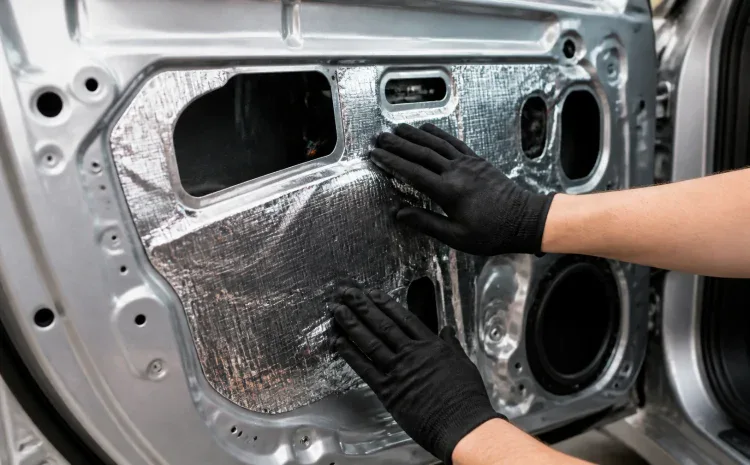
These are the heavy, silver sheets you often see in installation photos. Butyl is a constrained-layer damper. Its job isn’t necessarily to “block” sound, but to stop the metal from vibrating. By adding mass and changing the resonant frequency of the panel, it turns vibration into a tiny amount of heat. This is the first and most important step for any audio upgrade in Calgary.
Closed-Cell Foam (The Absorbers)
Once the vibration is under control, we use closed-cell foam layers. This material acts as a decoupling agent. It prevents plastic door panels from rubbing against the metal (which causes those annoying squeaks and rattles) and helps absorb higher-frequency airborne noises like wind hiss.
Key Areas to Treat for Maximum Results
If you aren’t ready to do a full “vehicle wrap” in sound-deadening material, there are specific areas that offer the best bang for your buck:
- The Doors: This is where your primary speakers live. Treating the inner and outer skins of the doors provides the most noticeable improvement in audio quality.
- The Wheel Wells: For drivers throughout Southern Alberta who deal with gravel, slush, and road salt, treating the wheel wells can significantly cut down on the “pinging” sounds and road roar.
- The Trunk or Hatch: If you are adding a subwoofer, the trunk area is a must. Large flat panels in the rear of a vehicle are notorious for vibrating when the bass hits.
- The Floor Pan: Treating the floor helps eliminate the low-frequency rumble that comes from the drivetrain and tires.
The Difference Professional Installation Makes
It is tempting to look at sound deadening as a simple “peel and stick” project. However, the effectiveness of the material depends entirely on the bond it makes with the metal. Professional installers at Wright ReStyling use specialized rollers and preparation techniques to ensure that there are no air bubbles or gaps.
In our climate, where temperatures can swing from -30°C to +30°C in a single week, a proper bond is critical. If the material isn’t applied correctly, it can peel away inside the door, potentially interfering with window tracks or trapping moisture that can lead to corrosion. When we perform sound deadening in Calgary, we take the time to clean every surface and apply the material strategically, focusing on the areas that provide the most acoustic benefit without adding unnecessary weight to the vehicle.
Making Every Drive a Better Experience
At the end of the day, sound deadening isn’t just about the music: it’s about the overall quality of your time behind the wheel. A treated car feels more solid. The doors close with a satisfying “thud” rather than a tinny “clang.” Conversations are easier to hold at highway speeds, and you arrive at your destination feeling less fatigued because your brain hasn’t been subconsciously filtering out road noise for an hour.
If you have invested in a high-quality audio system, don’t let it be hampered by a noisy cabin. Whether you are driving a brand-new EV or a classic truck, the right sound treatment can transform your vehicle into a true mobile concert hall.
Ready to Silence the Noise?
If you are tired of road noise drowning out your favorite tracks, or if you want to get the absolute most out of your audio system, the team at Wright ReStyling is here to help. We have decades of experience restyling vehicles and optimizing them for the best possible performance.
Stop by our shop or give us a call to discuss how we can tailor a sound-deadening package for your specific vehicle. Let’s make your next drive through Calgary the quietest, most musical one yet.