
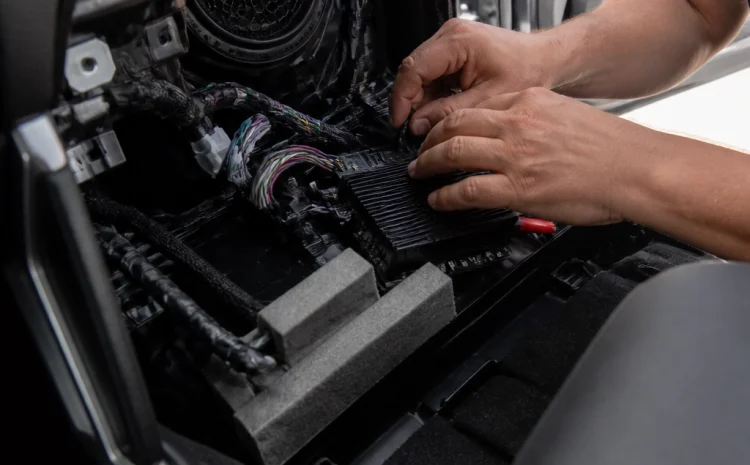
Why Your Car Audio Sounds Worse Than It Should: The Overlooked Role of Proper Tuning
You invested in better speakers, added an amplifier, or installed a subwoofer: but the system still sounds harsh, muddy, or strangely unbalanced. The bass may feel disconnected from the rest of the music, vocals may seem stuck near the driver’s door, and turning up the volume only makes the problems more obvious.
Before replacing more equipment, consider the upgrade-then-tune gap.
Many car audio systems receive plenty of attention during installation but very little calibration afterward. The hardware may be capable of excellent performance, yet incorrect gain levels, crossover settings, equalization, and speaker timing can prevent it from reaching its potential.
For drivers in Calgary and throughout Southern Alberta, proper tuning is especially important. Road noise, winter tires, large glass surfaces, hard interior materials, and the vehicle’s unique cabin shape all affect how music reaches your ears. The same speakers can sound dramatically different in two different vehicles: or even from the passenger seat compared with the driver’s seat.
Better hardware is only part of the solution
A quality speaker or amplifier does not automatically produce quality sound. Every vehicle cabin creates an acoustic environment that is difficult to control.
The driver sits much closer to the speakers on one side of the vehicle than the other. Sound reflects off the windshield, windows, dashboard, seats, and door panels. Road and tire noise compete with quieter musical details. Factory systems may also send an altered signal to the speakers, making it important to integrate aftermarket equipment correctly.
That is why professional car audio upgrades in Calgary should be viewed as a complete system rather than a collection of individual components.
A successful upgrade considers:
- The vehicle’s factory audio signal
- Speaker placement and mounting
- Amplifier power and gain structure
- Crossover points
- Sound deadening and panel resonance
- The driver’s preferred listening position
- The desired balance between volume, clarity, and bass
Installing better equipment without addressing these factors can leave you with a system that is louder, but not necessarily more enjoyable.
What proper car audio tuning actually changes
Tuning is the process of adjusting the system so that each component works with the others and the sound is optimized for the vehicle cabin. It is not simply turning up the bass or selecting a “rock” preset on the head unit.
A properly tuned system should deliver a stable front soundstage, clear vocals, controlled bass, and a smoother listening experience at different volume levels. The goal is to make the music feel more natural and connected: not to make every frequency as loud as possible.
Gain structure: getting clean power
Gain controls are often misunderstood. They are not simply volume knobs for an amplifier.
A gain setting matches the amplifier to the signal coming from the source unit. If the gain is too high, the amplifier can amplify distortion or clip the signal, producing harsh highs, muddy bass, and listening fatigue. If it is too low, the system may lack the dynamics and output you expected.
Good gain structure allows the system to play at a useful volume while preserving clarity. It also helps protect speakers from receiving a distorted signal when you turn up the music on a highway drive.
Crossovers: assigning the right frequencies
Crossovers determine which frequencies each speaker is responsible for reproducing. They help prevent a tweeter, midrange speaker, midbass driver, or subwoofer from working outside its useful range.
Poor crossover settings can create several familiar problems:
- Tweeters sound sharp or aggressive
- Midrange vocals become nasal or muddy
- Midbass lacks impact
- The subwoofer sounds separate from the front speakers
- Certain frequencies seem to disappear entirely
The ideal crossover settings depend on the speakers, enclosure, amplifier, vehicle, and listening goals. There is no universal setting that works perfectly in every car. A professional installation should use sensible starting points and then refine them by measurement and listening.
Why the driver’s seat matters so much
Home audio systems are usually arranged with a symmetrical listening position in mind. A vehicle is not.
From the driver’s seat, the left-side speakers are much closer to you than the right-side speakers. Without correction, sound from the near speakers reaches your ears first. The result is often a soundstage that pulls toward the driver’s door instead of appearing across the dashboard.
This is where time alignment becomes valuable.
Creating a realistic soundstage
Time alignment uses delay to compensate for the different distances between each speaker and the listener. The closer speakers are delayed slightly so sound from the entire front stage reaches the driver more coherently.
When adjusted correctly, the lead vocal can appear to come from the centre of the dashboard rather than directly beside your left shoulder. Instruments become easier to place, and the music feels wider and more focused.
This is sometimes described as imaging. A well-imaged system gives you a clearer sense of where vocals, drums, guitars, and other instruments are positioned. You may not be able to see the soundstage, but you can hear that it is stable and organized.
The listening position must be considered during the tuning process. A system optimized for the driver’s seat may not sound identical from the passenger seat. That is not necessarily a flaw; it is a result of working within the asymmetrical design of a vehicle cabin.

Equalization should correct: not exaggerate: the sound
Equalization can help address peaks and dips caused by the vehicle’s acoustics, but it cannot solve every installation problem. Large boosts are often used to compensate for weak bass or missing detail, yet they can add distortion and put unnecessary strain on the speakers and amplifier.
A more controlled approach generally involves:
- Establishing the correct gain levels
- Setting appropriate crossovers
- Confirming speaker polarity and phase
- Applying time alignment
- Adjusting channel levels
- Using equalization for fine correction
- Listening to familiar music and making small final adjustments
Small changes are usually more effective than extreme settings. If a system requires major EQ boosts to sound acceptable, the underlying issue may be speaker placement, installation, phase, road noise, or an unsuitable component match.
Sound deadening gives the system a better environment
Even a well-tuned audio system has to compete with the road. Tire noise, wind, rattling panels, and vibration can cover up detail and make the system seem weaker than it really is.
This is particularly noticeable on Calgary-area roads and longer drives on Deerfoot Trail, Stoney Trail, or major routes throughout Southern Alberta. When the cabin is noisy, drivers often turn up the volume to hear vocals and quieter passages. That can make distortion and fatigue more noticeable.
Vehicle sound deadening can reduce unwanted vibration and road noise while helping speakers perform more consistently. Treating the appropriate areas of the vehicle may improve midbass response, reduce panel rattles, and create a quieter background for music.
Sound deadening is not intended to eliminate every outside sound. A reasonable level of road awareness remains important for safe driving. Instead, the aim is to reduce the noise that competes with your music and conversations.
Common symptoms and what they can indicate
If your system sounds disappointing after an upgrade, the symptom may point toward a tuning or installation issue:
- Vocals pull toward the driver’s door: time alignment or left-to-right level balance may need adjustment.
- Treble sounds harsh: the gain, crossover, or EQ may be too aggressive.
- Bass sounds boomy: the subwoofer crossover may be too high, or cabin resonance may be exaggerating certain frequencies.
- Bass feels weak despite having a subwoofer: phase, polarity, crossover integration, or enclosure design may need attention.
- Music becomes tiring at moderate volume: distortion, excessive EQ boosts, or overly bright speaker output may be involved.
- The system sounds fine at low volume but falls apart when turned up: the amplifier may be clipping, or the speakers may be reaching their limits.
These symptoms do not always mean you need new equipment. In many cases, the system needs a careful assessment and calibration before further upgrades are considered.
Professional installation helps close the upgrade-then-tune gap
Car audio tuning is most effective when it begins with a solid installation. Speakers need secure mounting, wiring must be integrated correctly, and panels should be reassembled without introducing new rattles. Amplifiers and processors also need to be configured for the vehicle and the equipment they control.
At Wright ReStyling, the process can begin with understanding how you use your vehicle. A daily commuter may want clear speech and balanced music at highway speeds. Another driver may prioritize powerful bass, while someone else may want a subtle factory-style upgrade that improves detail without changing the interior appearance.
Our team has helped restyle more than 10,000 vehicles since 1999, serving Calgary and surrounding communities with personalized vehicle upgrades for all makes and models. Depending on the vehicle and goals, an audio project may include speaker upgrades, amplification, subwoofer integration, custom fabrication, and sound deadening.
Hear what your system is capable of
If your car audio sounds worse than it should, replacing more hardware may not be the answer. Proper tuning brings the components together, corrects the uneven acoustics of the cabin, and focuses the sound where you actually listen: from the driver’s seat.
Whether you are planning new aftermarket car electronics or trying to improve an existing system, Wright ReStyling can help assess the installation and identify the changes that will make the biggest difference. Contact our Calgary team to discuss your vehicle, listening preferences, and the right path for a clearer, more balanced drive.